
Key Insights

Blue Cross Blue Shield Association estimates that increased coding of complex conditions added $942 million in spending from 2023 through 2025 compared with 2023 patterns. Of that, $653 million was associated with increased secondary-condition coding during 2024 and 2025.
The surprising part is what did not change: BCBSA found no corresponding evidence of more treatment. For major bowel surgeries, coding for partial intestinal obstruction rose 55% and acidosis 33%, yet treatment patterns did not rise correspondingly.
AI can create positive ROI locally while raising costs system-wide. That is the governance problem CEOs and CFOs should care about.
Business Model Transformation + Framework
AI revenue-cycle tools change the incentive from finding documentation faster to finding every reimbursable condition hidden in the record. Providers may capture revenue and productivity gains, while payers, employers and ultimately patients absorb higher spending. The better model is evidence-linked reimbursement, where AI surfaces diagnoses but clinical evidence and human validation determine what reaches the bill.
My framework is The Evidence to Reimbursement Funnel: Clinical Data -> AI Analysis -> Evidence Validation -> Coding -> Reimbursement. The managerial takeaway is simple: measure AI ROI across the healthcare system, not just inside the department buying the tool.
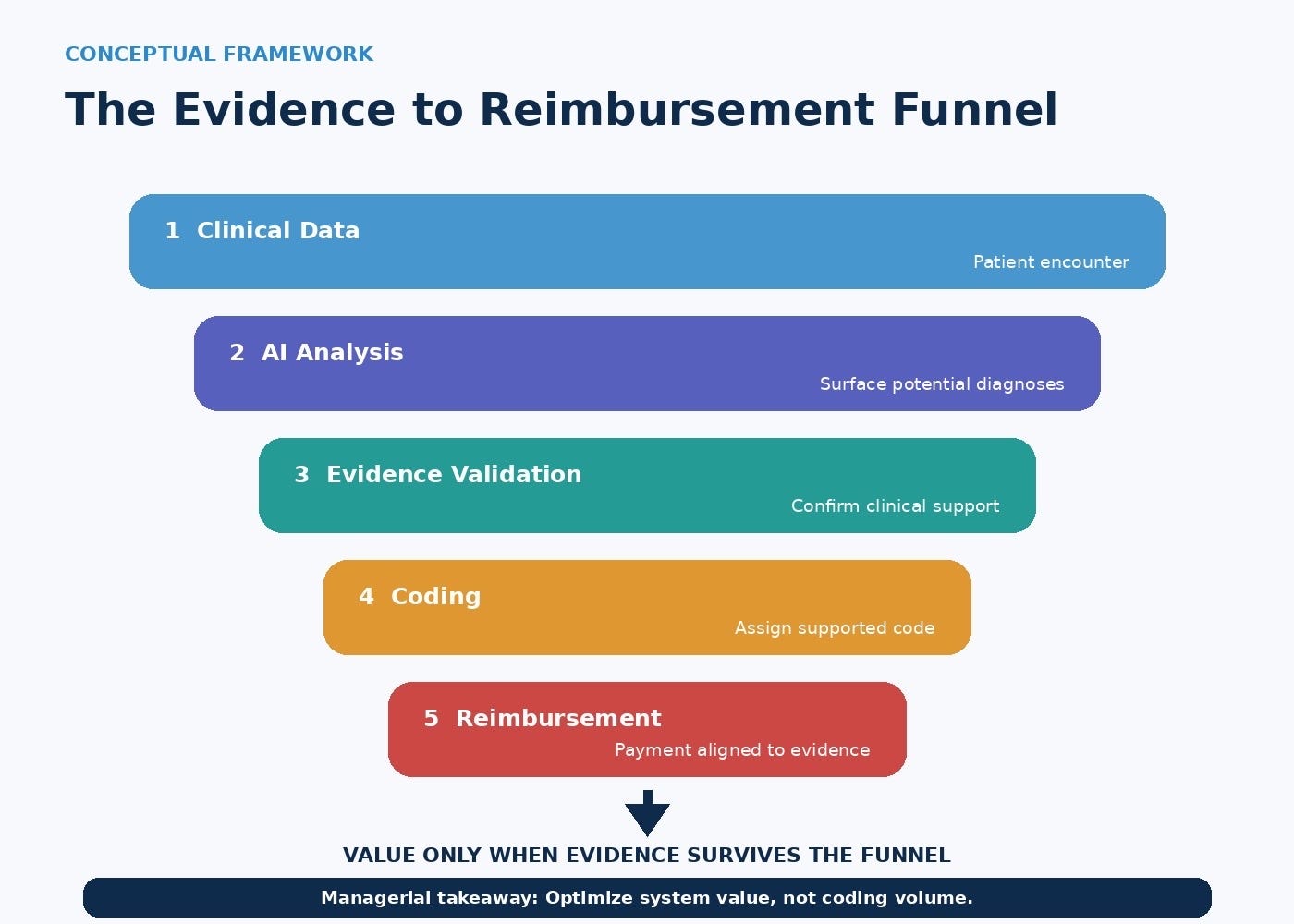
BEFORE: Record review -> Manual coding -> Claim -> Payment
AFTER: Clinical data -> AI suggestion -> Evidence validation -> Supported claim -> Repeat
This is also a useful operational lesson beyond coding. AI makes previously expensive tasks cheap, so organizations will inevitably do more of them. The question becomes whether increased activity creates increased value. Governance should therefore track downstream outcomes alongside productivity: coding intensity, treatment changes, denials, payer cost and patient cost.
Why this matters for Live150.ai
The same principle applies to personalized health guidance. More AI recommendations do not automatically create more health value. What matters is whether guidance changes behavior and ultimately improves outcomes. AI economics should increasingly be measured from action to outcome, not merely from automation to output.
So here is the question for every healthcare executive deploying AI:
Is your AI creating value, or simply getting better at capturing it from someone else?
AI Dictionary
Coding intensity: The documented clinical complexity used in reimbursement.
Evidence gate: A validation step requiring clinical support before an AI-generated recommendation proceeds.
Sources & Further Reading
Reuters, September 24, 2026
Reporting on BCBSA’s analysis of AI-assisted coding and nearly $1 billion in additional healthcare spending.
https://www.reuters.com/legal/litigation/ai-tools-generated-nearly-1-billion-extra-costs-blue-cross-insurers-say-2026-09-24/
Blue Cross Blue Shield Association, September 24, 2026
Primary analysis of claims data, coding changes, treatment patterns and the estimated $942 million spending impact.
https://www.bcbs.com/about-us/association-news/bcbsa-analysis-ai-coding-tools-affects-healthcare-costs
AI coding that raises reimbursement without changing treatment is a billing machine wearing a care badge. the hospital celebrates ROI, the payer sends the bill onward, and patients get told AI made healthcare cheaper. publish the treatment delta next to every dollar claimed as savings.